
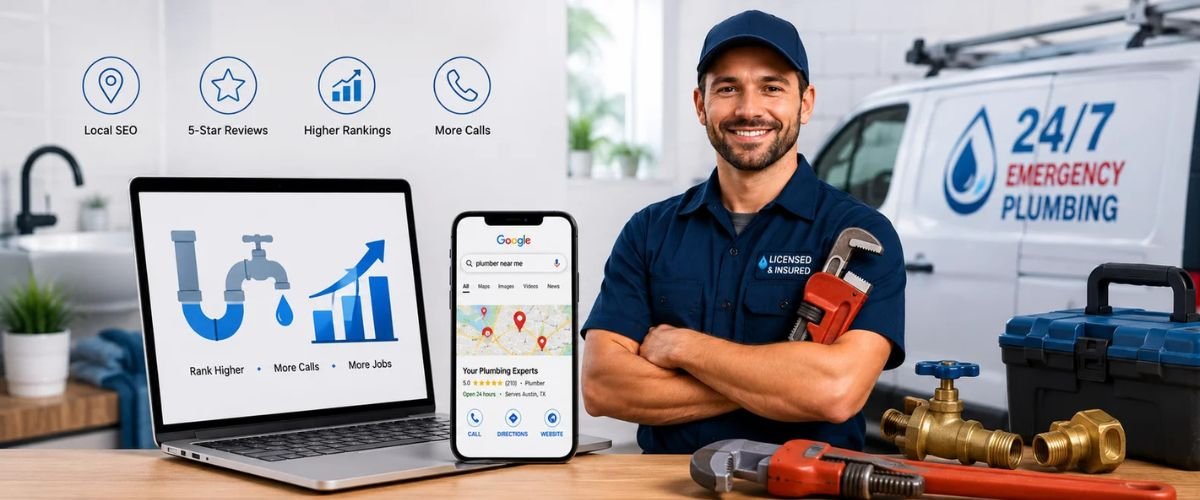
SEO for Plumbing Business Websites: The Complete Guide to Ranking Higher & Booking More Jobs
When a pipe bursts at 2 AM, nobody flips through a phone book. They grab their phone, type “emergency plumber near me,” and call one of the first three businesses they see. If your plumbing business website isn’t ranking on that first page — or in the Google Map Pack — that job goes straight to your competitor.
That’s exactly what SEO for plumbing business websites solves. Search engine optimization turns your website into a 24/7 lead-generation machine that brings in calls, bookings, and revenue without paying for every single click. In this guide, you’ll learn how plumbing SEO works, which keywords actually convert, and the step-by-step strategy to dominate local search rankings in your service area.
What Is Plumbing SEO?
Plumbing SEO is the process of optimizing your website, Google Business Profile, and overall online presence so your business appears at the top of search results when homeowners search for services like drain cleaning, water heater repair, or emergency plumbing in your city.
- Local SEO — ranking in the Google Map Pack and "near me" searches
- On-page SEO — optimizing service pages, meta titles, headers, and content
- Technical SEO — site speed, mobile-friendliness, schema markup, and crawlability
- Off-page SEO — reviews, local citations, and backlinks that build authority
Why SEO Matters More for Plumbers Than Almost Any Other Industry
Plumbing demand is urgent and hyper-local. Customers don’t research for weeks — they decide in minutes based on who shows up first and who has the best reviews. Consider:
- The majority of plumbing searches happen on mobile devices, often during emergencies
- Most searchers click one of the top 3 results and never scroll further
- Unlike paid ads, organic rankings keep generating leads without per-click costs
- A strong review profile + Map Pack position captures calls before competitors are even seen
SEO vs. Google Ads for Plumbers: Which Wins?
| Factor | SEO (Organic) | Google Ads (PPC) |
|---|---|---|
| Cost per lead | Decreases over time | $50–$300+ per lead, ongoing |
| Speed of results | 3–6 months | Immediate |
| Trust factor | High (organic = credibility) | Lower (marked “Sponsored”) |
| Longevity | Compounds for years | Stops the moment you pause spend |
| Best for | Long-term growth engine | Quick wins & new service launches |
Verdict: Smart plumbing companies use both — Ads for immediate volume, SEO as the long-term revenue engine that eventually lowers total marketing cost.
Step 1: Keyword Research — Target What Customers Actually Type
Effective keyword research for plumbers means matching search intent. Broad terms like “plumber” attract unqualified traffic; localized, high-intent phrases attract people ready to book.
Plumbing Keyword Intent Map:
| Keyword Type | Examples | Intent | Priority |
|---|---|---|---|
| Emergency | emergency plumber near me, 24 hour plumber | Transactional (urgent) | ★★★★★ |
| Service + Location | drain cleaning in [city], water heater repair [city] | Transactional | ★★★★★ |
| High-ticket services | tankless water heater installation, trenchless sewer repair | Commercial | ★★★★☆ |
| Problem-based | no hot water in house, sewer backup in basement | Commercial | ★★★★☆ |
| Informational | how to unclog a drain, water heater lifespan | Informational | ★★★☆☆ |
Pro tip: Long-tail plumbing keywords like “tankless water heater installation cost in [city]” have lower volume but far higher conversion rates and less competition — perfect for a small plumbing business competing against big franchises.
Step 2: Dominate the Google Map Pack with Your Google Business Profile
Your Google Business Profile (GBP) is the single most powerful local SEO asset you own. To optimize it:
- Claim and verify your listing at business.google.com
- Choose the right categories: Plumber, Emergency Plumbing Service, Water Heater Repair
- Add your service area, hours (mark 24/7 if true), phone, and website
- Upload real job photos weekly — trucks, technicians, before/after work
- Publish Google Posts about seasonal offers and services
- Keep NAP consistency (Name, Address, Phone) identical across every directory
Step 3: Build Service Pages and Location Pages That Rank
One generic “Services” page won’t cut it. Google ranks dedicated pages for specific queries.
- Create one page per service: drain cleaning, sewer line repair, leak detection, repiping, water heater installation, sump pumps, gas lines
- Create one page per city/suburb you serve, with unique local content — not copy-paste duplicates
- Optimize every page with a keyword-rich meta title (e.g., "Drain Cleaning in Austin, TX | Same-Day Service"), a compelling meta description, and proper H1/H2 headers
- Add click-to-call buttons, trust badges, license numbers, and review snippets to convert visitors into calls
Step 4: Technical SEO — The Foundation Most Plumbers Skip
A slow, broken website kills rankings and conversions. Your technical checklist:
- Page speed: compress images, use fast hosting, aim for under 3-second loads
- Mobile-first design: over 60% of plumbing searches are on phones
- SSL certificate (HTTPS) — a confirmed ranking factor
- Schema markup: add LocalBusiness/Plumber structured data plus FAQ schema so Google displays rich results
- XML sitemap submitted to Google Search Console; fix broken links and crawl errors
Step 5: Reviews, Citations & Backlinks — Your Authority Engine
- Reviews: Ask every satisfied customer for a Google review via text link. Respond to all reviews — positive and negative. Review velocity and rating directly influence Map Pack rankings.
- Local citations: Get listed on Yelp, Angi, HomeAdvisor, BBB, Thumbtack, Nextdoor, and local chamber directories with identical NAP details.
- Backlinks: Sponsor local sports teams, join trade associations, earn mentions from local news, and partner with complementary trades (HVAC, electricians) for referral links.
Step 6: Content Marketing & Emerging Search
Publish helpful content that answers real customer questions — “how much does water heater replacement cost,” “signs of a hidden water leak,” “hard water problems.” This builds E-E-A-T signals and captures customers earlier in their journey.
Also optimize for what’s next: voice search (“Hey Google, find a plumber open now”) favors conversational FAQ content, and AI search engines increasingly pull answers from well-structured, authoritative pages — another reason FAQ schema matters.
How Long Does Plumbing SEO Take? (Realistic Timeline)
| Timeframe | What to Expect |
|---|---|
| Month 1–2 | GBP optimized, technical fixes, keyword mapping done |
| Month 3–4 | Long-tail rankings appear; Map Pack movement in smaller areas |
| Month 5–6 | Service pages ranking; calls from organic search increase |
| Month 7–12 | Competitive keyword rankings; SEO becomes top lead source |
Common Plumbing SEO Mistakes to Avoid
- Targeting broad national keywords instead of local, high-intent terms
- Duplicate content across location pages
- Ignoring reviews or never responding to them
- No call tracking — you can't improve what you don't measure
- A website with no dedicated service pages
Frequently Asked Questions (FAQ)
Q1. How much does SEO cost for a plumbing business?
Most plumbing companies invest $500–$3,000/month depending on market size and competition. DIY is possible for small markets, but agencies typically accelerate results.
Q2. Can I do plumbing SEO myself?
Yes — start with your Google Business Profile, service pages, and reviews. Technical SEO and link building are where most owners eventually bring in help.
Q3. What are the best keywords for a plumbing website?
High-intent local terms: “plumber near me,” “emergency plumber [city],” “drain cleaning [city],” “water heater repair [city],” plus high-margin terms like “tankless water heater installation.”
Q4. Is SEO better than paid ads for plumbers?
SEO delivers cheaper leads long-term and builds lasting visibility; ads deliver instant volume. The best strategy combines both, shifting budget toward SEO as rankings grow.
Q5. How do I rank in the Google Map Pack?
SEO delivers cheaper leads long-term and builds lasting visibility; ads deliver instant volume. The best strategy combines both, shifting budget toward SEO as rankings groOptimize your GBP completely, collect consistent 5-star reviews, maintain NAP consistency across citations, and build locally relevant website content.w.
Q6. Do plumbing blogs actually help SEO?
Yes. Informational content captures early-stage searchers, earns backlinks, strengthens topical authority, and feeds voice/AI search results.
Final Takeaway
SEO for plumbing business websites isn’t a one-time task — it’s a compounding system: a fast, mobile-friendly website + optimized Google Business Profile + dedicated service and location pages + steady reviews and citations. Nail these fundamentals, stay consistent for 6–12 months, and your website becomes your best-performing technician: one that books jobs around the clock and never calls in sick.